
The first public say on the plan that decides where Guildford builds 1,151 homes a year opens in early September for six weeks. What the council asks, how to respond.
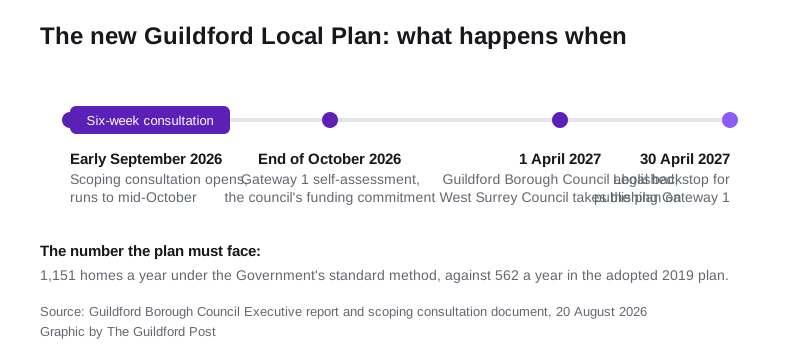
The first public consultation on Guildford’s new Local Plan will open in early September and run for six weeks, to the middle of October. The council’s Executive agreed the consultation document on 20 August, clearing the last step before the plan that will decide where the borough builds into the 2040s goes out for comment.
This is a scoping consultation, the stage the Government’s March 2026 plan-making regulations require before a council can formally start writing. It does not propose any sites. What it asks is what the plan should cover, which local issues matter most, and how the council should involve people as the plan is written.
The number underneath it all: 1,151 homes a year
The consultation document confirms the Government’s standard method currently puts Guildford’s housing need at 1,151 homes a year, roughly double the 562 a year the adopted 2019 plan was built around. The new plan must seek to meet that figure over a 15-year horizon, plus a buffer for sites that fail to deliver.
It is not only housing. The council’s 2026 employment land assessment, quoted in the document, forecasts a need for 58,400 square metres of additional office floorspace and 20,800 square metres of industrial space by 2045.
Where all that goes is the spatial strategy, and the document is open that this is the hard part: in a borough where most undeveloped land is Green Belt, it walks through the factors in play, including the approach to the Green Belt, and asks whether residents agree with how the council plans to develop the strategy. The Green Belt assessment published in July, which graded 575 areas of the borough against the Government’s new grey belt test, is part of the evidence base it will draw on.
What you will actually be asked
The questionnaire asks residents to rank the top three issues under each of four themes, and to say what is missing:
- homes and healthy communities
- prosperity and economic resilience
- natural environment and heritage
- settlements and infrastructure
It also asks whether the council’s approach to the spatial strategy is right, what the plan’s key priorities should be, and how the council should engage people through the rest of the process.
The clock behind the dates
The timetable is tighter than it looks, for two reasons the Executive report sets out plainly. The regulations impose backstop dates: the Gateway 1 self-assessment of readiness must be published by 30 April 2027 at the absolute latest, and the council has committed to doing it by the end of October 2026 as a condition of its Local Plan implementation funding.
The second reason is reorganisation. Guildford Borough Council is abolished on 1 April 2027, and the plan passes mid-preparation to the new West Surrey Council. Government guidance says reorganisation is no excuse to slow down, and the Executive rejected the option of pausing. Whoever finishes the plan, the scoping questions being asked this autumn are the foundation it gets built on.
What it means for you
If you will ever want a say over whether a field near you is built on, the Local Plan is where that argument is actually decided, and this consultation shapes what the plan covers and how the later, site-specific stages are run. Responses go through the council’s online questionnaire once the consultation opens, or by email to planningpolicy@guildford.gov.uk. The responses will be summarised in a published report and used to shape the second, meatier consultation on the plan’s content.
The full picture of the borough’s planning arguments, including North Street, Weyside Urban Village and the housing numbers, is on our Guildford planning news page. Live applications are covered in Guildford planning applications.
Have your say