
AECOM's study classes 120 of Guildford's 575 Green Belt areas as grey belt and 307 provisionally, and a rule change due this autumn could take it to 551.
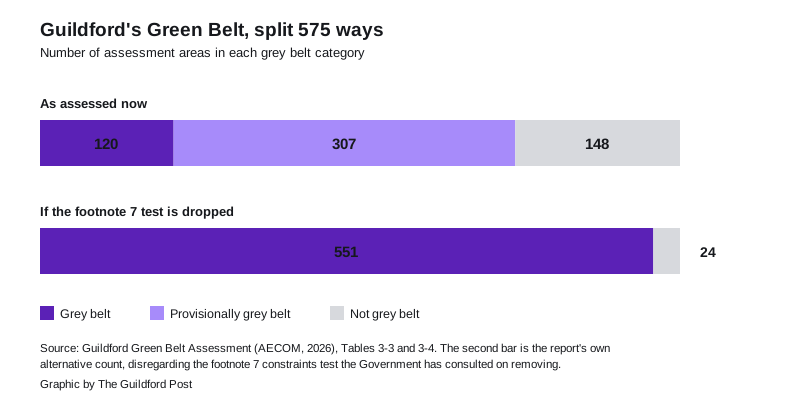
Guildford Borough Council has published the study that decides which of its Green Belt fields carry the Government’s new “grey belt” label, and the numbers in it are bigger than the council’s own announcement suggests. Consultants AECOM split the borough’s Green Belt into 575 assessment areas. They put 120 of them in the grey belt category, 307 in a second category called “provisionally grey belt”, and only 148 outside both (Guildford Green Belt Assessment, Table 3-3).
Measured by land rather than by count, the report’s own conclusion is blunter: 7% of Guildford’s Green Belt meets the grey belt definition and a further 73% is provisional grey belt, leaving one fifth of the borough’s Green Belt clearly outside the label.
Grey belt is not a local invention. It was introduced by the Government in the December 2024 National Planning Policy Framework and covers Green Belt land that does not strongly serve three of the five long-standing Green Belt purposes: checking the sprawl of large built-up areas, stopping neighbouring towns merging, and preserving the setting of historic towns. Councils were told to identify it, and given money to do so (council FAQs).
The number to watch is 551
The “provisional” category exists only because of a second test. Land that fails the three purposes can still be kept out of grey belt if it carries what planners call footnote 7 constraints: a Site of Special Scientific Interest, the Thames Basin Heaths Special Protection Area, ancient woodland, Local Green Space, the Surrey Hills National Landscape, listed buildings and conservation areas, or a real flood risk. Where those constraints might be mitigated, AECOM could not reach a final answer without a specific scheme to judge, so the area was marked provisional.
The Government consulted earlier this year on removing that test from the definition. The council’s own FAQ says it expects the final version of the framework in the autumn, and that if the change goes through, “the GBA will be re-issued without the Footnote 7 component” and the provisional category disappears.
AECOM has already run that scenario. Table 3-4 of the report counts what happens if the footnote 7 test is disregarded: 551 of the 575 areas would be grey belt, and 24 would not.
Where the grey belt land is
The report does not rank places, but Appendix A lists the conclusion reached for every assessment area, and the reference codes are grouped by settlement. Counting that table, The Post found the 120 grey belt areas are not spread evenly. Our count of the appendix matched the report’s totals exactly for grey belt (120) and not grey belt (148).
The heaviest concentrations sit tight against the villages, not out in open countryside:
- East Horsley: 14 of its 32 areas are grey belt, more than any other settlement.
- Wood Street Village: 8 of 10, the highest proportion in the borough.
- Send (8 of 16) and Send Marsh and Burntcommon (8 of 17).
- West Clandon: 7 of 12.
- Shalford: 5 of 10, and Fairlands 4 of 8.
- The Green Belt ring around Guildford town itself: 17 of 75 areas.
- The wider countryside, which AECOM assessed as 184 larger “outer Green Belt” areas, produced just 23.
Villages matter here for a technical reason. National guidance says none of the Green Belt purposes relate to villages, so land around a village has fewer ways to score strongly, and the borough’s Local Plan defines which of its settlements count as villages rather than towns.
What grey belt does and does not do
It does not grant planning permission. The council’s news release is emphatic that identifying land as grey belt “does not mean all sites are necessarily suitable for development”, and that the study makes no decisions about which land will be allocated. The report says the same: the findings “do not in themselves indicate an AA is suitable for Green Belt release”.
Councillor Fiona White, lead councillor for planning, said: “We know that any changes to Green Belt policy will be a concern for residents. That’s why it’s important for us to be clear. This assessment does not mean development will automatically happen on any of these sites.”
What grey belt does is unlock an argument. Under the framework, building on grey belt can be acceptable where there is a proven need, a sustainable location, and the scheme meets the Government’s “golden rules”, which for housing means 50% affordable homes rather than the usual 40%. On need, the council’s FAQ concedes the point already: “The current lack of a five-year housing land supply means that there is a proven need for housing.”
That combination is why the label matters before any Local Plan allocation is made. It is already the argument in live cases: the outline scheme for 200 homes at Shortlands Farm in Ash, now with the Planning Inspectorate, rests on the developer’s case that the land is grey belt rather than ordinary Green Belt.
What it means for you
- Nothing has been allocated. No site in the borough has been earmarked for development by this study. The first public consultation on the new Local Plan is due in September and October 2026, and that is the stage at which locations get proposed.
- Check your own patch now. Appendix E of the report maps every area reference, the council has an interactive map on the assessment page, and Appendix B carries a one-page proforma for each area explaining exactly why it scored as it did. If you live in East Horsley, Send, Wood Street Village or West Clandon, your surrounding fields are more likely than not to be in one of the two grey belt categories.
- Watch the autumn framework. If the footnote 7 test goes, the constraints that currently hold 307 areas in the “provisional” bucket stop counting at this stage, and the study gets re-issued. The protection those designations give does not vanish, but it moves to the planning application, where it is argued site by site.
- A grey belt application can already land on your doorstep. The council decides these cases now, under the current framework, without waiting for the new Local Plan. Applications are listed on the council’s planning register.
The next phase of AECOM’s work, a wider assessment of what removing land would do to the Green Belt as a whole, only starts once the council has drafted a spatial strategy and candidate sites. On the current timetable, that lands with the authority that replaces Guildford Borough Council: West Surrey Council takes over on 1 April 2027.
Have your say