
A re-issued council study classes 92% of Guildford's Green Belt as grey belt, 551 of 575 areas, after the August NPPF dropped the flood and SSSI carve-out.
Guildford Borough Council has quietly re-issued the study that labels its Green Belt, and the new version puts 92% of it in the Government’s “grey belt” category. The report’s own conclusion is blunt: “92% of the Green Belt has been identified as grey belt”, with the remaining 8% outside the definition (Guildford Green Belt Assessment, paragraph 4.1.2).
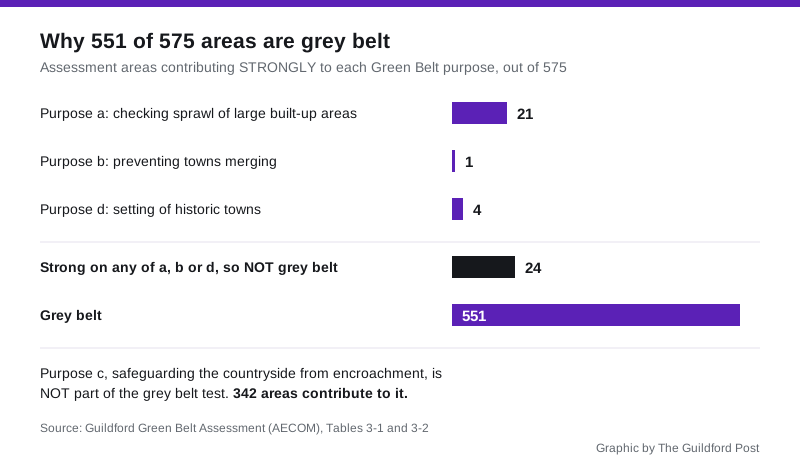
Counted by parcel rather than by area, the study splits the borough’s Green Belt into 575 assessment areas. 551 of them are now grey belt. Twenty-four are not (Table 3-2).
That is a different document from the one published in July. Consultants AECOM then found 120 areas grey belt, 307 “provisionally grey belt” and 148 outside both. The middle category has gone.
The council has not announced the re-issue. The replacement file was loaded onto the council’s website on 1 September 2026, according to the timestamp the site attaches to it, and the updated FAQs went up 15 minutes later. Council web pages carry no publication dates.
Why the number moved
The reason is national, not local. A new National Planning Policy Framework was published on 17 August 2026, and it changed what grey belt means.
The council explains the change itself in its updated assessment FAQs. The 2024 definition excluded Green Belt land carrying certain national constraints, known as footnote 7 constraints. Sites of Special Scientific Interest and land at high flood risk were the examples. “This no longer forms part of the definition,” the FAQs say.
The council is clear that this does not strip those protections away. It means only that they no longer decide whether land is grey belt. Any application on such land would still have to answer them.
We flagged this number in August, when the July report carried a second table showing what would happen if the footnote 7 test were dropped. That table said 551. It is now the headline figure.
Three purposes out of five, and none of them apply to villages
Grey belt is land that does not strongly contribute to any of three Green Belt purposes set out in NPPF policy GB2:
- purpose a: checking the unrestricted sprawl of large built-up areas
- purpose b: preventing neighbouring towns merging into one another
- purpose d: preserving the setting and special character of historic towns
An area only has to contribute strongly to one of the three to escape the label. Across the whole borough, just 24 of 575 areas manage it (Table 3-1). Taken one at a time the counts are smaller still:
- purpose a: 21 areas contribute strongly
- purpose b: one area
- purpose d: four areas, with 496 making no contribution at all
Two things explain that. The first is the settlement list. Only Guildford, and Ash and Tongham as part of the Blackwater Valley urban area, count as large built-up areas here. Guildford is the borough’s only historic town. Everywhere else in the borough, from Albury and Effingham to Ripley, Send, Shere, West Clandon, Worplesdon and Wood Street Village, is classified as a village, and the council quotes the Government’s guidance directly: “none of the Green Belt purposes relate to ‘villages’”.
The second is which purposes were left out. Purpose c, safeguarding the countryside from encroachment, is not part of the grey belt test. 342 of the 575 areas do contribute to it. So a field can keep open countryside open, be recorded in this report as doing exactly that, and still be grey belt.
What grey belt does not mean
It is not planning permission, and it is not an allocation. Cllr Fiona White, Lead Councillor for Planning, said on the council’s assessment page: “This assessment does not mean development will automatically happen on any of these sites.”
The report agrees. Being grey belt “simply means land does not perform strongly against the NPPF Green Belt purposes a, b or d”, and AECOM writes that “it is expected that a lot of grey belt may not meet” the further tests for development.
Those further tests are where the argument will now happen. Under NPPF policy GB7, development on grey belt also needs a proven need, a sustainable location, and compliance with the golden rules. Here the council’s own FAQs concede one of them already: “The current lack of a five-year housing land supply means that there is a proven need for housing.” The golden rules then require 50% affordable housing rather than the usual 40%.
The pressure behind all of this is the housing figure. Under the Government’s standard method, Guildford’s local housing need is 1,168 homes a year, well above what the adopted plan provides for, and the report was commissioned to support a review of Green Belt boundaries for the new Local Plan.
What happens next
A second stage is still to come. Once the council has a draft spatial strategy and candidate sites, AECOM will assess whether releasing them together would “fundamentally undermine” the five Green Belt purposes across the plan area. That stage does look at purpose c, and at purpose e, urban regeneration.
What it means for you
- Nothing has been allocated and nothing has been permitted. The study is evidence for the Local Plan. It changes the argument, not the map.
- If you want to know how your local fields were assessed, the council’s interactive map and Appendix E give each area a reference number, and Appendix B holds the detailed assessment for that number, on the Green Belt Assessment page.
- The place to object is the Local Plan, not this report. Consultation on the plan is the stage where sites are proposed. Live applications are a separate matter and are tracked on our Guildford planning applications page.
- Expect the label in application documents. Applicants will now cite grey belt status for land where the previous report said “provisionally” grey belt, or nothing at all. The council says a decision maker must still make its own site-specific assessment, because an application site may cover only part of an assessment area.
Where the borough’s bigger planning arguments stand, including the Local Plan timetable, is set out on our Guildford planning news page.
Sources: Guildford Green Belt Assessment, re-issued report (AECOM, 2026); Guildford Green Belt Assessment FAQs, updated August 2026; National Planning Policy Framework, published 17 August 2026; Green Belt planning practice guidance.
Have your say