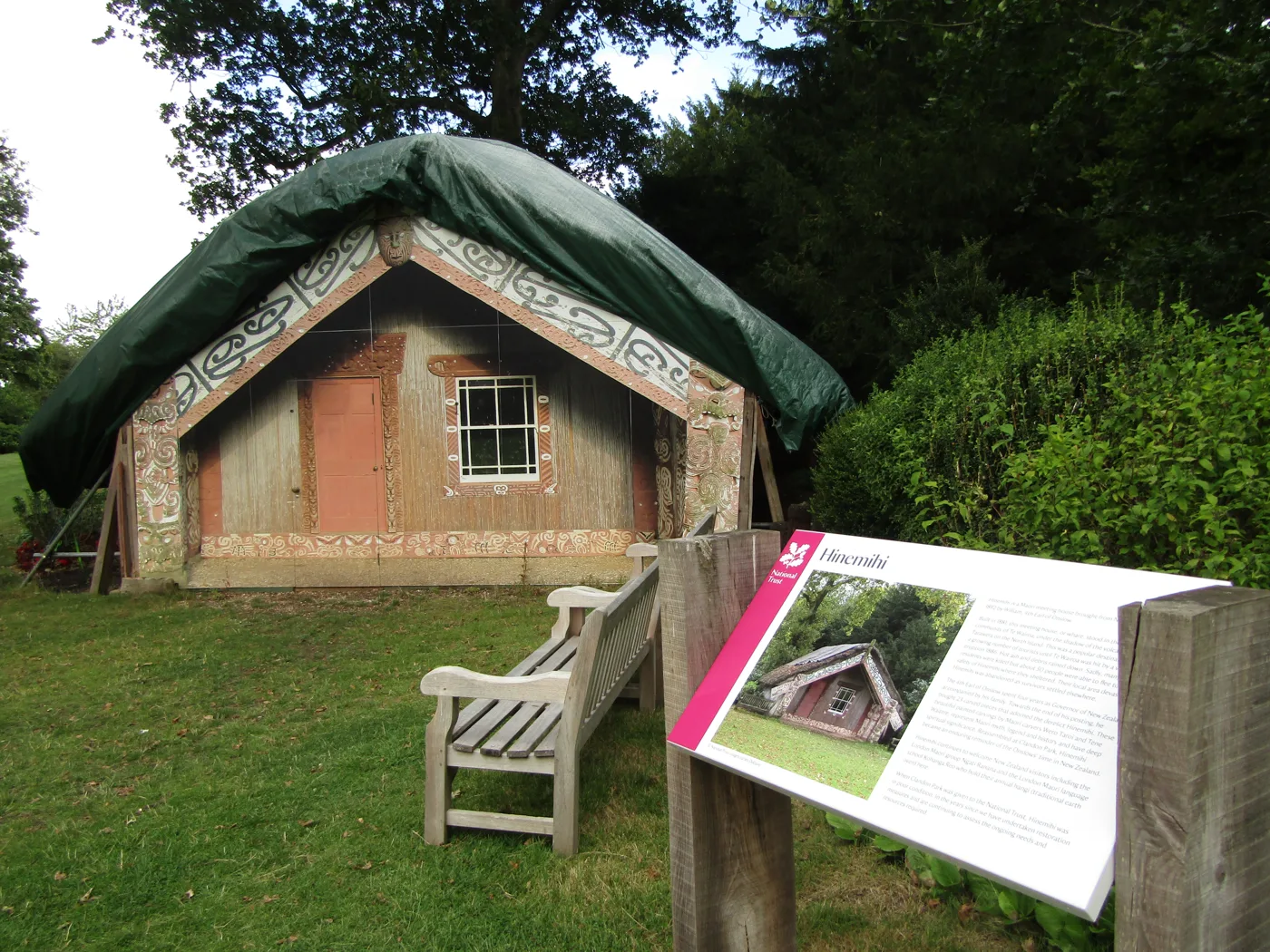

The National Trust wants to send Hinemihi's 1880 carvings home to New Zealand and build a replacement meeting house at Clandon. Comments close on 16 October.
The National Trust has applied to Guildford Borough Council for permission to remove the carvings from Hinemihi, the Māori meeting house at Clandon Park, permanently, and send them home to New Zealand. In their place, a new body of carvings made by Māori carvers in New Zealand would be gifted to Clandon and mounted on a replacement timber-framed building on the same spot.
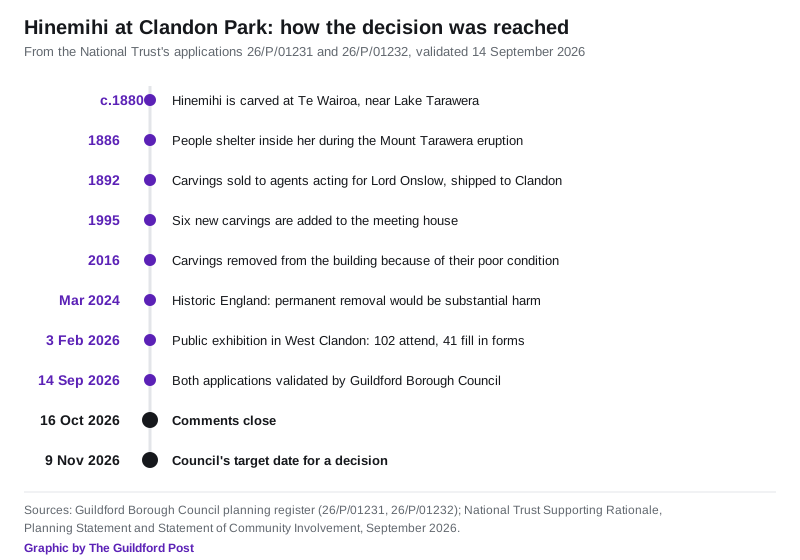
Two applications were validated on 14 September 2026: planning permission under reference 26/P/01231 and listed building consent under 26/P/01232. Both are open for public comment until Friday 16 October, and the council’s own target date for a decision is Monday 9 November 2026 (Guildford Borough Council planning register).
This is not a routine listed building case. The National Trust’s own planning statement accepts that taking the carvings away would cause substantial harm to a Grade II listed building. Under national planning policy, that is a finding councils are told should be exceptional.
What is actually being proposed
The Trust’s submission breaks into three parts.
- The carvings leave for good. Hinemihi’s whakairo, the carvings dating from around 1880 together with six added in 1995 and the Lovers Carving, would be returned to Ngāti Hinemihi in Aotearoa. Heritage New Zealand Pouhere Taonga would legally receive them.
- A new body of carvings comes to Clandon. These would be carved in New Zealand, including by descendants of the original carvers, designed specifically for Clandon, and given a new name. The planning statement says they would draw on “the history of the site, the local Clandon context and the enduring relationship between NZ and the UK”.
- The building itself is replaced. The existing timber-framed structure would be dismantled and rebuilt, reusing what can be salvaged, including tōtara timber originally imported from New Zealand, along with existing rafters, wall framing and elm boarding.
The replacement would be marginally bigger. It grows from about 8m to 8.7m in length and from 5.84m to 6.2m in width, taking the gross external area from about 47 square metres to 53. The new thatched roof would have a slimmer profile than the present one, which the Trust says is closer to traditional form and should stop the structural problems recurring. The building shifts very slightly to avoid nearby tree roots, and the historic path between the mansion house and the meeting house would be reinstated in permeable gravel.
Why the Trust says the carvings have to go
Hinemihi was carved at Te Wairoa, near Lake Tarawera, around 1880. When Mount Tarawera erupted in 1886, people sheltered inside her and survived. Ngāti Hinemihi, the hapū descended from the ancestress Hinemihi, say many of their present generation owe their lives to that night.
In 1892 the carvings were sold to agents acting for the 4th Earl of Onslow, who had been Governor of New Zealand, and shipped to Clandon. All three project partners state plainly in the application that this was a lawful purchase and that the project is not a restitution claim based on theft, plunder or duress. It is framed as an exchange.
The second reason is physical. The carvings were taken off the building in 2016 because of their poor condition, and detailed assessments in 2024 used the National Trust’s own conservation grading. Several of the external and porch carvings, including the amo, the pane, the epa and the paepae, were graded D for condition, meaning considerable loss, damage or disfigurement, and iv for stability, meaning a change in condition is likely within a year.
Rangitihi Pene, writing for Ngāti Hinemihi and the charitable trust Ngā Kohinga Whakairo o Hinemihi, puts the case this way in the submission: “The carving exchange seeks to honour our shared past. The 4th Earl of Onslow had great affection for his time as Governor General of Aotearoa New Zealand. His fondness for our Māori culture drove his desire to buy a whare, which ended up being Hinemihi.”
Ngāti Hinemihi intend to re-establish Hinemihi on her original site at Te Wairoa as a heritage attraction.
The heritage argument the council now has to settle
The council is not being asked to rubber-stamp this. It is being asked to decide whether substantial harm to a listed building is justified by public benefit, which is one of the highest bars in the planning system.
The paper trail on that question is unusually long:
- Historic England first gave high-level advice in January 2018
- its advisory committee considered the project on 9 November 2023, and detailed pre-application advice followed in March 2024, finding that permanent removal would cause substantial harm but that the case could be an exceptional one
- Historic England issued final pre-application advice on 28 August 2026, confirming the applications were ready to be made and recognising the carvings’ communal and spiritual value
- Guildford Borough Council issued its own final pre-application advice on 3 September 2026, agreeing that substantial harm was likely and stating that the threshold for justifying it is “extremely high”
The council also advised that dismantling and replacing the structure would cause additional harm, but at the lower end of the scale, and that the scheme is unlikely to count as inappropriate development in the Green Belt.
The national amenity societies were briefed by Historic England at its London offices in April 2026. Historic Buildings & Places, the Society for the Protection of Ancient Buildings, the Georgian Group and Surrey Gardens Trust attended. Historic Buildings & Places later wrote that it agreed the removal would be substantial harm, but concluded the proposals were justified in these exceptional circumstances and raised no objection in principle. The Victorian Society supported the return in principle but asked for more on the long-term stewardship of the carvings once they are back in New Zealand before giving final advice.
What the local consultation found
The Trust held a free one-day public exhibition at the Royal British Legion in West Clandon on 3 February 2026, open from 10am to 7pm. Its statement of community involvement records that 102 people attended the exhibition events and 41 questionnaires were completed.
Of those local attendees:
- 95% strongly supported or supported the return of Hinemihi’s carvings
- 92.5% strongly supported or supported the proposals for the replacement meeting house
Those percentages rest on 41 responses, so they are a reading of who turned up rather than a survey of the village. In New Zealand, a separate online survey found support for the exchange at 98% among wider Ngāti Hinemihi respondents.
What it means for you
If you live in West Clandon, or anywhere in the borough, this is a decision your council makes and one you can write to it about.
- Comments close on Friday 16 October 2026. Both applications share that date, and both are advertised in the press on 25 September.
- Comment on the reference that matches your point. Use 26/P/01231 for the physical building, the path and the landscape, and 26/P/01232 for the listed building consent covering the carvings themselves.
- The full evidence is public. The supporting rationale, the statement of community involvement, the heritage impact assessment and the drawings are all on the council’s planning register. The rationale runs to 50 pages and includes the statements of support from all three partners.
- The decision target is 9 November 2026. Guildford Borough Council is abolished on 1 April 2027 and replaced by West Surrey Council, so on current timings this decision falls to Guildford.
- Nothing changes at Clandon this month. The existing consent covering the temporary removal of the external carvings runs until 3 December 2026.
How to comment, and what counts as a valid planning objection, is set out in our guide to Guildford planning applications.
The sources
- Guildford Borough Council planning register: 26/P/01231, the planning application, with all supporting documents
- Guildford Borough Council planning register: 26/P/01232, the listed building consent application
- The Hinemihi Project Supporting Rationale, the Planning Statement and the Statement of Community Involvement, all National Trust submissions dated September 2026 and downloadable from the register pages above
Frequently asked questions
Is Hinemihi being taken away from Clandon Park?
Her carvings would be, permanently. The National Trust has applied for listed building consent to remove Hinemihi’s whakairo and return them to Ngāti Hinemihi in New Zealand, with Heritage New Zealand Pouhere Taonga legally receiving them. A Māori meeting house would remain at Clandon: a replacement timber-framed building carrying a new body of carvings made in New Zealand and given a new name (Guildford Borough Council planning register, 26/P/01232).
When can I comment, and when is it decided?
Comments on both applications close on Friday 16 October 2026. The council’s internal target date for a decision is Monday 9 November 2026. Both applications are advertised in the press on 25 September.
Why does the Trust say the carvings need to leave?
Two reasons are given in the submission. The first is cultural: Ngāti Hinemihi want the carvings home, and intend to re-establish Hinemihi at her original site at Te Wairoa. The second is physical: the carvings were taken off the building in 2016 because of their condition, and 2024 assessments graded several of the external and porch carvings D for condition and iv for stability, the National Trust’s own lowest grades.
Was Hinemihi taken from New Zealand unlawfully?
No, and the application is explicit about it. All three project partners state that the 4th Earl of Onslow’s purchase of the carvings in 1892 was lawful, and that the project is not a restitution claim based on theft, plunder or duress. It is framed as a reciprocal exchange.
Figures, dates and quotations in this article are taken from the applications as published on Guildford Borough Council’s planning register and were checked on 21 September 2026. Applications can be amended or withdrawn before a decision is made.
Have your say